Essaouira with a baby or a toddler: what really works before age 3
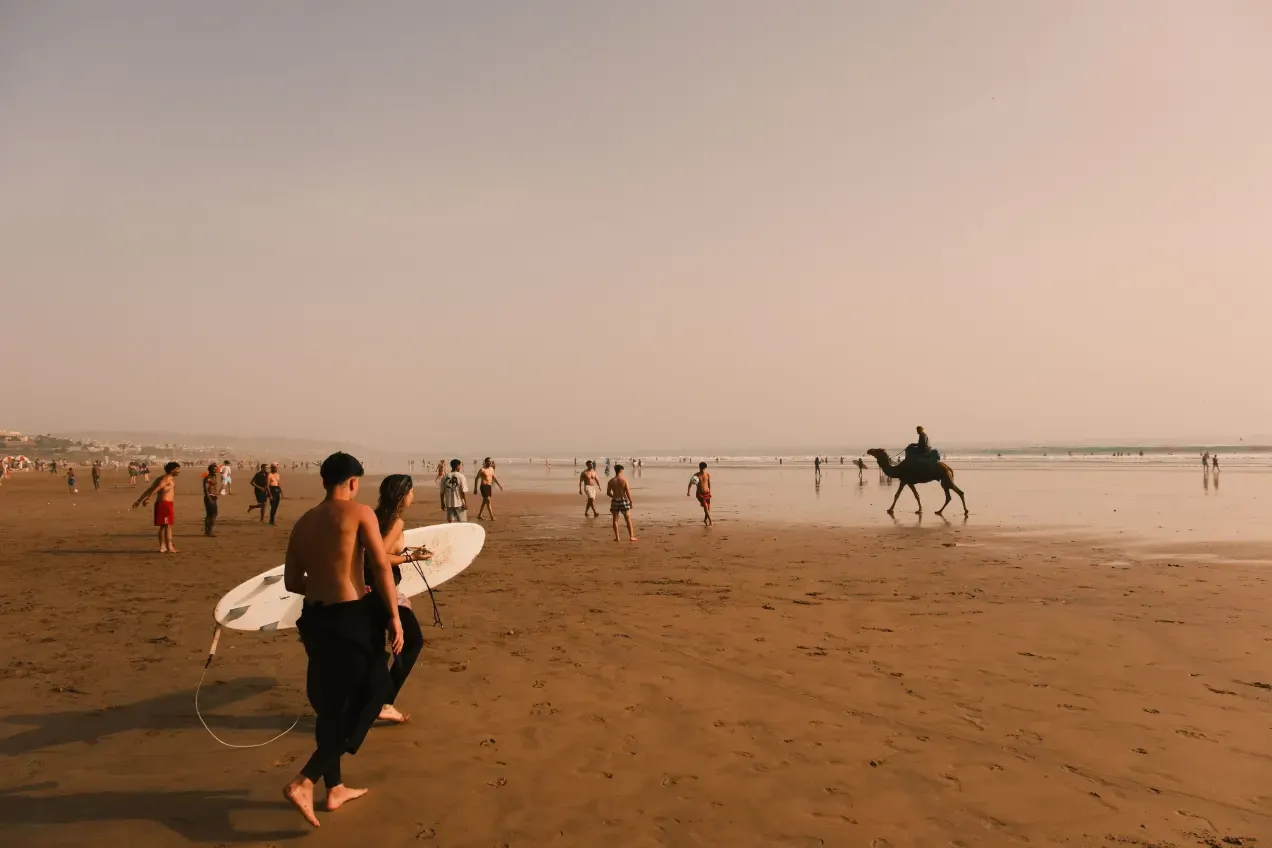
Essaouira is not the most obvious Moroccan destination for a baby, and we would rather say so up front: the Atlantic sits at around 19 °C all year, the wind picks up most afternoons, and the workshop catalogue starts at age 3.
Essaouira also has four rare advantages: a flat, pedestrian medina, very short transfers, a beach where no child gets lost, and a pace already close to a toddler's. Our guides to Essaouira with family and Essaouira with kids in summer are written for children who walk and swim. This one is about the first three years.
The real trap: it feels cool, and the UV index reaches 11
Essaouira is almost never hot: average highs of 18 to 22 °C across the year according to Climats et Voyages, 19 °C in January and 25 °C in August according to Weather Spark. The wind keeps that coolness going, so parents cover up less and stay out longer.
Radiation, though, does not follow temperature. According to Weather2Travel, Essaouira's maximum UV index reaches 9 in May, 10 in June and August, and 11 in July. On the scale published by the French health insurance service, 5 to 6 is already high, 7 to 8 very high, and anything above 9 extreme. Essaouira therefore spends its summer in extreme UV, at 22 °C, with cool wind on the skin: the exact recipe for holiday sunburn.
What that means in practice, following World Health Organization and French health service guidance:
- a child under 12 months stays in the shade at all times, with no exceptions;
- never let an infant sleep in the sun, parasols included;
- clothing is the best barrier, tightly woven or UV-protective fabric, long sleeves and a wide-brimmed hat, which blocks roughly 70 % of UV, plus an SPF 50 broad-spectrum cream reapplied every two hours;
- avoid the middle of the day outright.
One field note worth more than any list: a parasol pushed into Essaouira sand does not hold, the wind turns it. A framed beach tent, closed on three sides, shields from radiation and from blowing sand at once.
Month by month, what the climate allows
| Month | High (°C) | Max UV index | Mean wind (km/h) | Sea (°C) | Rain (days) | With a toddler |
|---|---|---|---|---|---|---|
| January | 18 to 19 | 3 | 17.7 | 17.5 | 7 | Calm and mild, but the wettest stretch |
| February | 19 | 5 | 19.1 | 17 | 7 | Still calm, moderate UV |
| March | 20 | 7 | 19.7 | 17 | 7 | Good compromise, cold sea |
| April | 19 to 21 | 8 | 21.1 | 17.5 | 6 | Wind settles in, very high UV |
| May | 20 to 22 | 9 | 21.8 | 18.5 | 3 | Very high UV, steady wind |
| June | 21 to 23 | 10 | 22.7 | 20 | 1 | Wind and UV near their peak |
| July | 22 to 25 | 11 | 23.7 | 21 | 0 | The hardest month of the twelve |
| August | 22 to 25 | 10 | 22.1 | 21.5 | 1 | Warm for Essaouira, and very windy |
| September | 22 to 25 | 8 | 19.0 | 21.5 | 2 | Very good: warm sea, wind easing |
| October | 22 to 23 | 6 | 17.5 | 21 | 5 | The best month of the year |
| November | 21 | 4 | 18.0 | 20 | 7 | Mild and calm, but rain returns |
| December | 19 to 20 | 3 | 18.2 | 18.5 | 7 | Calm, sea still at 18.5 °C |
Highs, sea temperature and rain days: Climats et Voyages (air, 1991-2020 averages). Upper end of the highs and wind: Weather Spark. Maximum UV index: Weather2Travel.
The sea never exceeds 21.5 °C, so real swimming is years away. Essaouira's beach is a sand destination, not a bathing one, and that is good news in disguise: sand keeps an 18-month-old as busy as a pool does.
The wind is a daily cycle rather than a constant. The north-easterly trade wind builds through the afternoon, where local watersports schools report it reaching around 30 knots, and Weather Spark places the windiest period between 7 April and 1 September. Before noon sand stays on the ground; between 2 and 6 pm it flies at face and pushchair height. Our article on wind in Essaouira explains the mechanism.
Rainy days cluster from November to March: Essaouira on a rainy day gives a plan B for every activity.
The flat, car-free medina is advantage number one
Moroccan medinas have a well-earned reputation as sloping labyrinths. Essaouira's is an exception, for a historical reason: it was laid out in the 18th century on a regular plan by the architect Théodore Cornut, four quarters and two perpendicular main streets used mainly by pedestrians. That plan, UNESCO-listed in 2001, is what makes the town navigable with a pushchair when Fez and Marrakech are not.
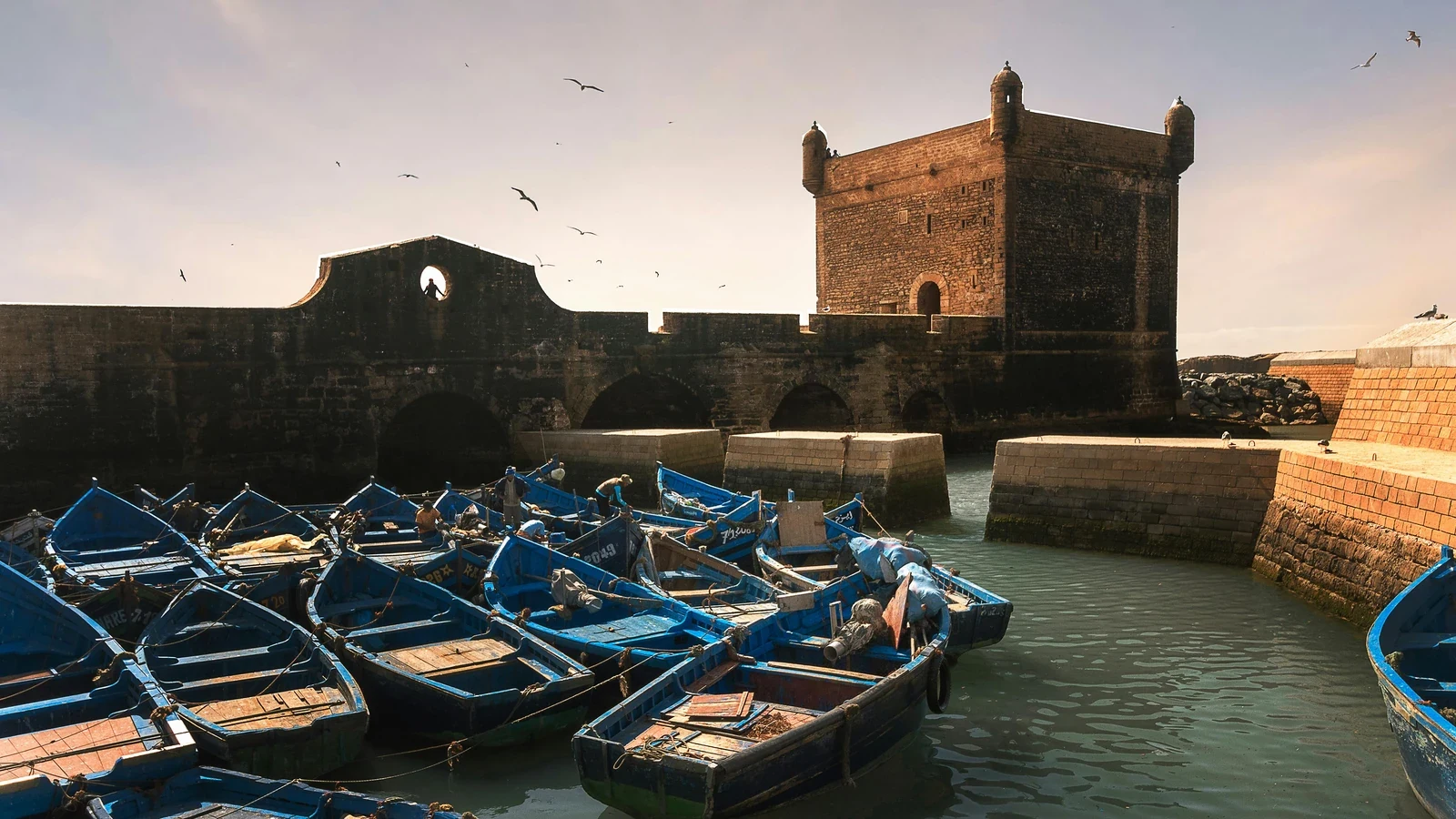
Three honest caveats: the side lanes are narrow and crowded in the late afternoon; the ramparts and the Skala are reached by stairs, so bring a carrier; the ground is paved, rollable but uneven, which argues for air-filled tyres. On the other hand, the fishing port in late morning is the safest attraction of the trip for a two-year-old: blue boats, gulls, noise, and nothing to pay.
For the first morning, a guided medina tour settles the orientation question in one go, and the traditional markets are best early.
Which catalogue activities work before age 3
Most workshops have a minimum age, and before 3 the list is short.
| Activity | Minimum age | Duration | Before age 3 |
|---|---|---|---|
| Birdwatching | not stated, page says accessible to all | 2 hrs 30 | Yes, in a carrier |
| Valleys and oasis of Sidi M'Barek | from age 2 | 1 hr 30 to 2 hrs | Yes, from age 2 |
| Donkey ride | to confirm with the operator | half day | Depends on age, ask first |
| Creative pottery, hand-building | from age 3 | 2 hrs | Just about, at 3 |
| Ceramic painting | from age 6 | 2 hrs | No |
| Surf lessons | from age 7 to 8 | varies | No |
| Horse ride | from age 8 | 1 hr to full day | No |
| Cooking workshops | from age 12 | 4 hrs | No |
| Buggy | from age 16 | 1 hr to full day | No |
Pottery, ceramic painting, valleys and oasis, and horse riding ages come from the activity pages; the others are the ages published in our summer family guide.
The best candidate is birdwatching: 2 hours 30, 300 dirhams per person, binoculars provided, transport included, and a page that describes it as accessible to all. Essaouira's wetlands and archipelago have been a Ramsar site since 15 January 2005. A carried baby sleeps very well through it, and the best season, autumn and spring, is exactly the window we recommend below.
Close behind comes the valleys and oasis walk at Sidi M'Barek: 1 hour 30 to 2 hours on an easy route with no climbing, listed for ages 2 to 80, and a child can ride a donkey for part of the way.
The other short outings with transport included travel well too, outside nap time: the Aïn Lahjer oasis, the argan forest and traditional fishing. For the donkey ride at Sidi M'Barek, as for a camel ride, check the minimum age and how the child is seated before booking. By contrast, the Sidi M'Barek coastal walk follows mule paths downhill, described without filter in our article on Sidi M'Barek, and surfing waits for swimming age.
From the third birthday onwards, the pottery workshop opens up: 2 hours of hand-building, 350 dirhams at the adult rate and 290 dirhams from 3 to 18, Monday to Saturday between 10 am and 5 pm. As far as we know, it is the earliest supervised activity in town, and our article on the pottery workshop walks through how a session runs.

The toddler window: September and October
If you can pick your dates, pick them here. Three figures converge, which is rare:
- the lightest wind of the year, averaging 17.5 km/h in October and 19.0 in September against 23.7 in July;
- the warmest sea of the year, 21.5 °C in September and 21 °C in October;
- a UV index back down, 8 in September and 6 in October, against 11 in July.
September and October therefore give the best climate for a toddler and the lowest visitor numbers, and it is also the right season for birding. March is the second choice, moderate wind and an index of 7, but a sea at 17 °C. July and August stack maximum wind on maximum UV: the two months to avoid with a baby, and precisely the ones families book. Our articles on when to go to Essaouira and Essaouira off season cover other travellers.
Health, transfers and logistics
No unusual health formality complicates a trip to Morocco with a baby: according to the Institut Pasteur there is no malaria transmission and no chemoprophylaxis is recommended, hepatitis A vaccination is advised from the age of 1 and typhoid from age 2 depending on conditions. Medical advice before departure remains the sensible step.
On the ground:
- sealed bottled water for bottles and teats;
- Sidi Mohamed Ben Abdellah hospital on Boulevard de l'Hôpital, and a night pharmacy at the municipality building on Avenue El Massira;
- the emergency numbers, 15 for medical help and 19 for police;
- nappies and formula are available in town, though not necessarily your brand.
On the road, Essaouira-Mogador airport sits 16 to 17 km from the centre, a 20 to 30 minute drive. Marrakech is roughly 175 km and 2 hrs 30 to 3 hrs away, Agadir about 173 km and 2 hrs 40. Our article on Essaouira as a day trip from Marrakech describes the there-and-back day: with a child under 3 that is 5 to 6 hours in a car for a few hours on site, so stay at least two nights. Private transport lets you request a car seat in advance, and car rental makes sense for the southern beaches in our local beach guide.
A day that actually holds together with a toddler
Built around the wind and the naps rather than a list of sights:
- 9 to 11.30 am: beach, beach tent, bucket and spade, before the wind builds;
- 11.30 am to 12.30 pm: walk back past the port, the boats and the gulls;
- 12.30 to 3.30 pm: lunch then a nap, the windiest slot of the day;
- 3.30 to 6 pm: the sheltered medina, a workshop for over-threes, or a nature outing;
- 6 to 7 pm: ramparts or the Skala in a carrier, for the evening light;
- 7 pm: an early dinner, since most places accommodate a small child.
The nap slot is also the slot for whichever adult is not sleeping: a treatment, a wellness traditions session or the hammam, taking turns.
What we honestly tell parents of babies
If your child is under 18 months and you want a week of beach, warm water and a supervised pool, Essaouira is not the most logical choice in Morocco: the Atlantic stays between 17 and 21.5 °C and the wind blows. Better to read it here than find out on arrival. Our Essaouira or Agadir comparison shows, with the numbers, when Agadir is the better call.
If instead you want a slow stay with no car, where everything is walkable and nobody looks at you sideways because the child cries in a restaurant, then the town works from the first months onward: that is the argument of our article on Essaouira as a slow travel destination.
The equation flips around age 5 or 6, when a child swims, climbs onto a donkey unaided and lasts two hours in a workshop. Essaouira then becomes hard to beat, and our 3-day itinerary and our article on the cost of a day take over.
Tell us your child's age and your dates
We will tell you in two lines what is workable and what is better left for later.