Hammam in Essaouira: the ritual, where to go, and what nobody tells you first
Almost every visitor asks the same thing, usually on the second evening, once the wind has dropped and the sea salt has dried on their skin: "can we do a proper hammam here, or is it only for locals?"
You can, and it is one of the things Essaouira does best. But it helps to know what you are walking into, because a Moroccan hammam is not a spa. No soft music, no rose petals, no whispering. It is a steam bath, a neighbourhood institution, a weekly habit, and a scrub vigorous enough that you leave with your skin squeaking.
Here is what actually happens, the four kinds of hammam you will find in town, and the time of day to book it: in a town this windy, that matters more than you would think.
Why a hammam is not a spa, and why that is the point
In a Moroccan medina the hammam was never a leisure facility. It is a neighbourhood institution, alongside the mosque, the fountain and the bread oven, with which it often shares a furnace: the same fire bakes the bread and heats the water. Locals go weekly.
Three practical consequences, which explain nearly every misunderstanding:
- It is not a quiet place. People talk, families catch up, children run about. The calm comes afterwards, not during.
- Hours are single sex and alternating: the same building takes men at certain times and women at others. Check this before you walk over.
- The scrub is a genuine scouring. The attendant is not being gentle, and that is exactly what you came for.
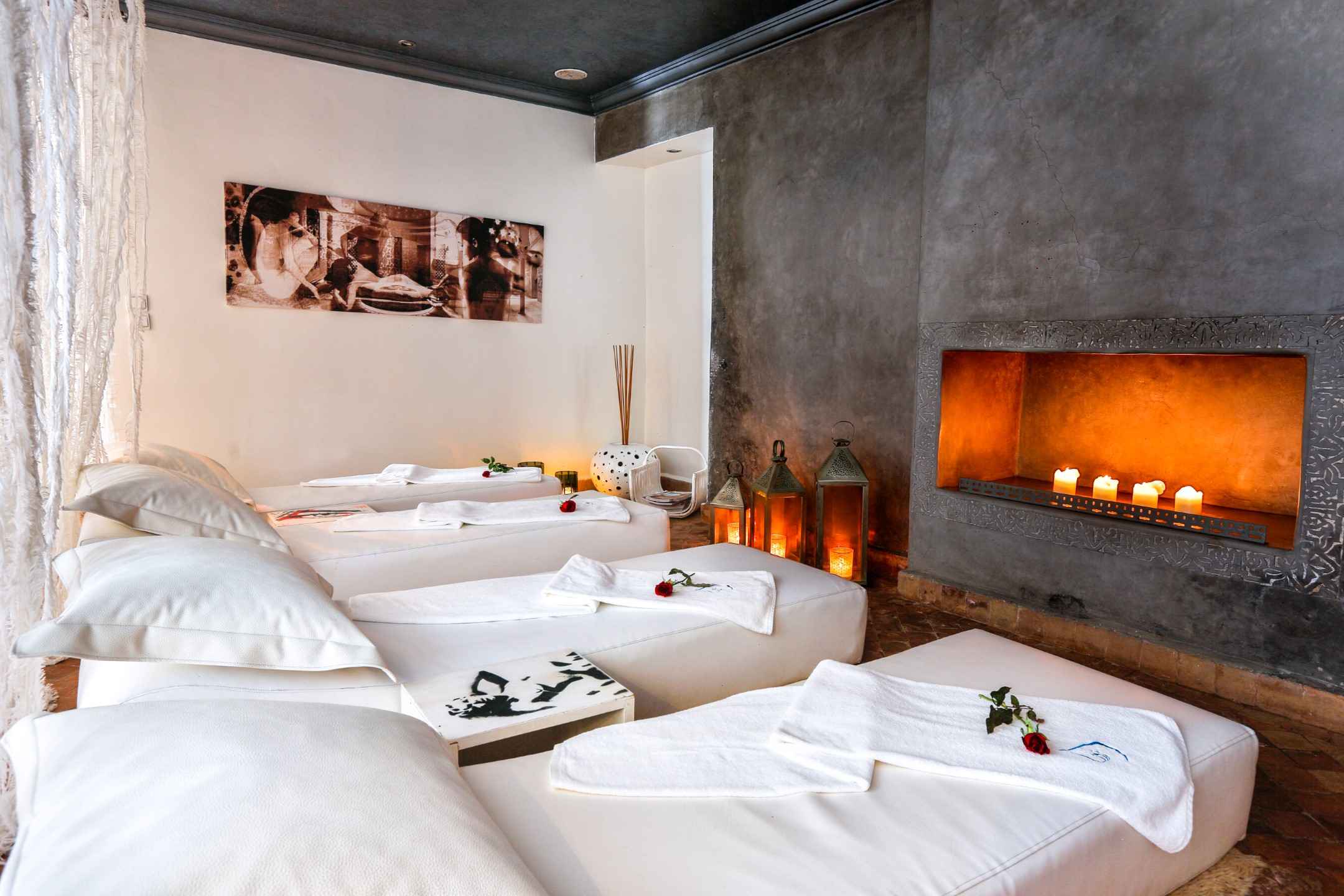
Alongside this neighbourhood bath there is a softer version, in riads and spas, with thick towels and booked time slots. Both are legitimate. They simply tell different stories, and the table below will help you choose.
The ritual, step by step
The sequence is much the same whether you are in a public bath or booking a guided traditional treatment.
- You start in a warm room, letting your body accept the heat. Do not skip this. It sets up everything that follows.
- You move into the hot room, thick with steam. You sit, you do nothing, you sweat: the skin needs to soften.
- You are coated in black soap, a soft olive based paste that barely lathers, left to sit for a few minutes.
- Then the scrub, with a kessa mitt that lifts off the dead skin. This is the spectacular part, and the most satisfying.
- A rinse with buckets of water, usually warm rather than hot.
- Then ghassoul, a Moroccan clay from the Atlas, worked into skin and hair. It cleans without stripping.
- Another rinse, then oil. In Essaouira that means argan oil, pressed from trees growing just inland.
- Finally, rest. Twenty minutes with water or mint tea. This is part of the treatment, not the end of it.
Allow an hour for a simple hammam, an hour and a half to two hours for a full ritual with a massage, and keep the rest of the day free: the heat empties you as much as it relaxes you.
Where to go in Essaouira: four options, four experiences
This is where the day is made or lost. All four exist in town, and the right one depends on what you came for.
| Option | Atmosphere | Typical length | What to bring | Best for |
|---|---|---|---|---|
| Neighbourhood hammam | Busy, loud, authentic, single sex | 1 hr | Black soap, kessa mitt, towel, flip flops, swimwear or underwear | Curious travellers comfortable with partial nudity and close quarters |
| Riad or guesthouse hammam | Intimate, small groups, usually booked ahead | 1 to 1.5 hrs | Nothing, everything is provided | Couples, first timers, anyone who wants the ritual without the crowd |
| Hotel spa | Hushed, à la carte, massage table | 1.5 to 2 hrs | Nothing | Comfort trips, rainy days, gifts |
| Private treatment at your riad or villa | Tailored, the therapist comes to you | Varies | Nothing, a quiet room is enough | Families, groups, guests with limited mobility |
Two things you will not read elsewhere.
First, the neighbourhood hammam requires some shopping. Nothing is provided: no soap, no mitt, no towel. All three cost very little in the medina markets, and buying them is half the fun. Turn up without them and the experience falls flat.
Second, if this is your first time, start with a guided treatment rather than the public bath. You will learn the sequence, the words and the gestures. The neighbourhood hammam is far better the second time, when you know what to do with your hands.
To go beyond the steam itself, local wellness traditions add an argan oil massage to the ritual, and that is the combination most of our guests end up choosing.
When to book it, and why it matters here
This is the most useful line in this guide, and it is specific to Essaouira.
After a hammam your pores are open, your skin has just been scoured and your hair is wet. Walking out into the late afternoon trade wind in that state is the surest way to catch a chill in a town that is otherwise mild. The wind fills in during the early afternoon and peaks at the end of the day, as our guide to Essaouira's wind explains in detail.
So three windows work well:
- Late morning, while the air is still calm, with a slow lunch afterwards.
- Late afternoon, as long as you go straight back and stay in until dinner.
- After a session on the water, which is by far the best combination. A morning of surfing in a sea that runs between 17 and 21 °C, or an afternoon of kitesurfing, then the hammam. Your shoulders will thank you the next day.
What to avoid: a hammam the night before an early flight or a long drive. You will sleep extraordinarily well, which is precisely the problem when the alarm goes at five.
It is also the best way to recover after a morning in the water: our surfing in Essaouira guide explains why surfers go out early.
The hammam through the year
Essaouira is mild all year and never hot. That is what makes the hammam worthwhile even in summer, unlike Marrakech.
| Season | Air, high | Sea | Rainy days per month | What it changes |
|---|---|---|---|---|
| Winter, December to February | 19 °C | 17 to 18 °C | 3.5 to 4.7 | The best season by far. Rooms here are rarely heated, so the hammam becomes a necessity as much as a pleasure |
| Spring, March to May | 20 to 22 °C | 17 to 18 °C | 0.9 to 3.9 | Ideal after a windy day, when the sand has found its way into everything |
| Summer, June to August | 23 to 25 °C | 19 to 20 °C | 0.1 to 0.2 | Still pleasant: it is not 40 °C outside, so the heat is a contrast rather than a punishment |
| Autumn, September to November | 21 to 25 °C | 19 to 21 °C | 0.8 to 4.6 | September has the warmest sea of the year, and is the best swim plus hammam combination |
Climate averages for the town. If your dates are not fixed yet, our guide to the best time to visit goes season by season.
Beyond the hammam: wellness in Essaouira
The town lends itself to this almost too well. The air is salty, the light is long and low, and nothing here encourages hurrying.
- Argan oil massage, which is a local product here rather than an imported luxury. The argan tree grows only in south west Morocco, and the practices and know how connected with it have been on the UNESCO list of intangible cultural heritage since 2014.
- A visit to the argan forest, to see where the oil comes from before it is worked into your back. The reverse order works too.
- A yoga session facing the Atlantic, in a small group or one to one.
- Pilates, more technical, which suits longer stays and backs worn out by travelling.
- A slow day at the Ain Lahjer oasis, sheltered from the wind, which counts as a treatment in itself.
- And on rainy days, a pottery class or a cooking workshop do surprising good, because your hands are busy and your head is not.
Etiquette, in seven lines
Nothing complicated, but these prevent most of the awkwardness.
- Keep swimwear or underwear on. Full nudity is not done.
- Bring your own kit to a neighbourhood hammam: black soap, kessa mitt, towel, flip flops, a comb, dry clothes to leave in.
- No photographs. Ever. It is a private space for the people who live here.
- Do not arrive on a full stomach, and do not arrive starving either. Two hours after a light meal is about right.
- Drink water before, during and especially after: dehydration is the only real risk.
- Tip the attendant who scrubs you. It is customary, and often most of their income.
- And accept that the first time feels strange. It does for everyone.
The mistakes we see most often
- Slotting it between two activities with no margin. A hammam is not a calendar entry, it is how a day ends.
- Choosing the public bath for a first time, with no idea of the sequence, and leaving after ten minutes.
- Following it with a walking tour of the medina when your legs have gone. Do it the other way round: medina first, hammam after.
- Saving it for the last evening, then realising you would have liked to go twice.
So which one should you pick?
To understand the town, a neighbourhood hammam, one afternoon, with your own kit and a little humility. You will remember it more sharply than any monument.
To genuinely switch off, a full ritual with scrub and massage, somewhere you are expected and everything is provided.
And if you are travelling as a family or with someone who struggles to get around, have the therapist come to you: nobody walks home wet into the wind.
Either way, keep the end of the day free. That is the only real requirement.