Surfing in Essaouira: which spot to pick for your level
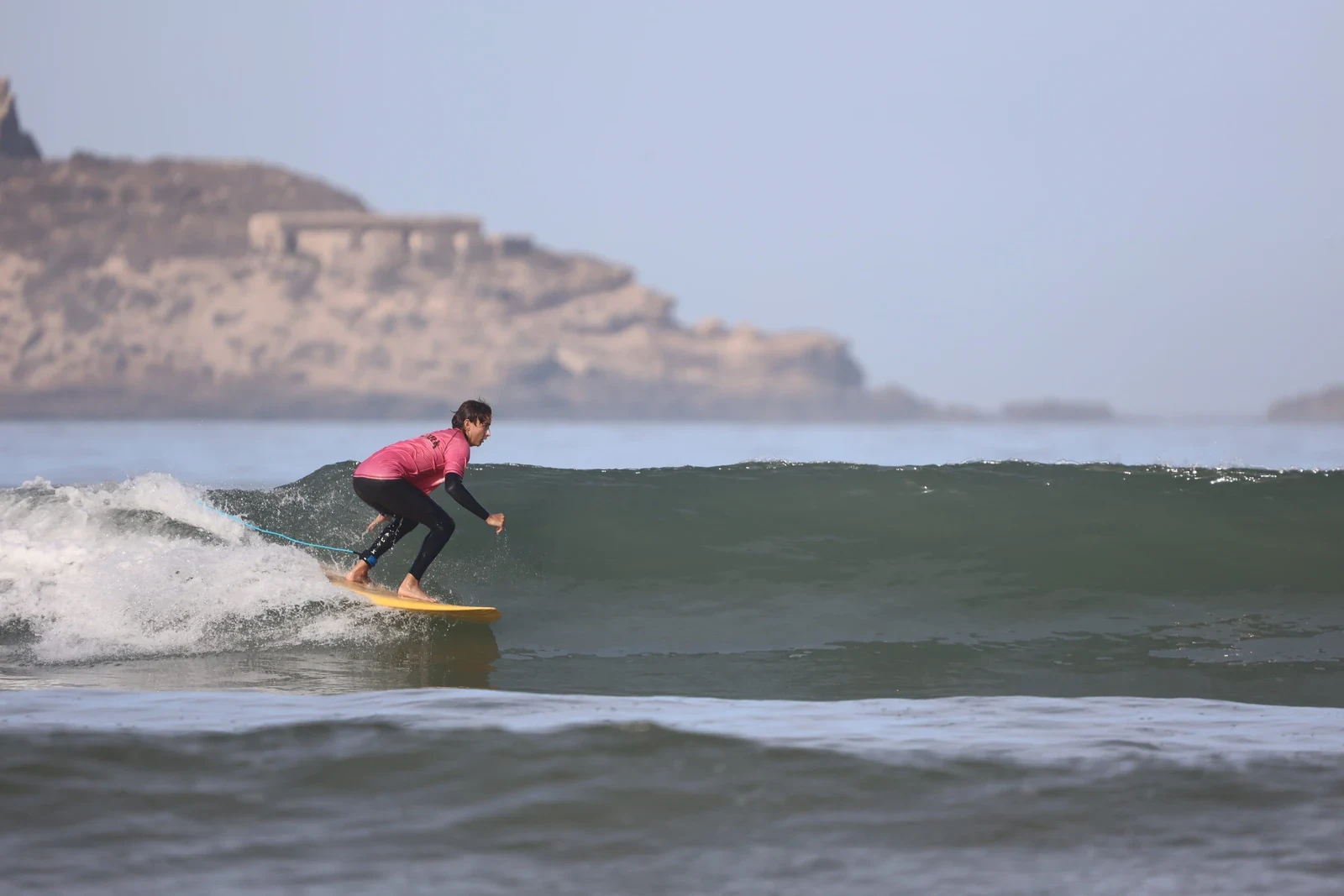
Essaouira is famous for wind, and that reputation has quietly buried a simple geographical fact: the town sits in the middle of an Atlantic coastline facing due west, with gentle waves in front of the medina and serious ones twenty minutes up the road.
So the question is not whether you can surf here. You can, all year round. The question is where, and at what time of day. Picking the wrong beach in Essaouira is the difference between a good first session and two hours of getting worked by a shorebreak that closes out.
Here are the six spots in the area, what each one actually asks of you, the time window that changes everything, and a season by season calendar.
Three things decide your session
Everything comes down to three factors, and together they explain why two beaches fifteen kilometres apart can have completely different waves on the same day.
- The swell comes from the northwest. That is the dominant direction along this stretch of coast. A spot open to it gets everything; a sheltered one gets almost nothing.
- The wind fills in during the afternoon. It is a thermal sea breeze, explained in detail in our guide to the wind in Essaouira. For a surfer it translates simply: glassy in the morning, choppy after lunch.
- Mogador island shelters the bay. The Purpuraires islands, just off the harbour, break up part of the swell before it reaches the town beach. That is precisely what makes the main beach a beginner spot, and Moulay Bouzerktoune, fifteen kilometres north with no shelter at all, an experienced one.
Remember the logic, you will use it every morning: the further you go from the bay, the bigger it gets.
The six spots, from mellow to serious
| Spot | Distance from Essaouira | Wave type | Level | Best season | What to know |
|---|---|---|---|---|---|
| Essaouira main beach | town centre, on foot | beach break sheltered by Mogador island | beginner | November to March | Works at all stages of the tide, rarely crowded |
| Tagharte, south end of the beach | 20 to 30 min walk | more exposed beach break | improving beginner | November to March | Closes out quickly as the swell builds |
| Cap Sim, towards Diabat | about 15 km south | right hand point break over sand and rock | intermediate | autumn and winter | Dirt track access, better with someone who knows it |
| Sidi Kaouki | 25 to 30 km south, 30 min drive | 2.5 km of beach break plus a rocky point | beginner to intermediate | November to April | Five or six distinct peaks, rocks and currents |
| Moulay Bouzerktoune | 15 km north, 30 min drive | powerful waves over a rocky bottom | experienced | winter swell, wind from spring to autumn | Unpatrolled beach |
| Tafedna | about 60 km south, 1 hr 30 | right hand point to the north, 4 km of peaks | all levels, but remote | October to April | You need a car, taxis do not go there |
Beginners: the town bay, and nothing else at first
This is the one point we will not bend on, and it is not excessive caution.
- The bottom is sand, with no rocks, along the whole length of the main beach.
- The island filters the swell. In winter the wave arrives around chest high, which is exactly the size you learn in.
- It works at all stages of the tide, so your session does not depend on a narrow window.
- You walk there from the medina, and you walk back. A detail, right up until the day your arms have gone.
- There is a school on the sand, which settles the question of boards and wetsuits.
The best window for a first time runs from April to June: the swell is small but consistent, and the wind has not yet reached its summer strength. A group lesson is plenty to have you standing up within the week.
One warning. The southern end of the beach, towards Tagharte, is more exposed and shuts down the moment the swell picks up. Our guide to Essaouira's beaches shows exactly where the calm zone ends.
Intermediates: Sidi Kaouki first, then Cap Sim
When the bay starts feeling too tame, the next step is half an hour south.
Sidi Kaouki is two and a half kilometres of beach with five or six distinct peaks, which means you choose your section instead of taking whatever is in front of you. The rocky point at the northern end throws a steeper first section that then opens up, and the peak in front of the marabout produces short lefts and more forgiving rights that almost anyone can ride. It works at all stages of the tide.
Two serious caveats. There are rocks, and there are rip currents. Stopping at a local school before you paddle out is not a courtesy, it is what saves you an hour of swimming against the current. Getting there takes about thirty minutes: a private transfer is a good deal simpler than haggling for a taxi on the way home, soaked and in the dark.
Cap Sim, towards Diabat, is the next step up: a right hand point break over sand and rock that asks for a genuine intermediate level and a dirt track to reach. It is also one of the finest pieces of coastline around, and you can get to know it without a board, for example on a buggy ride along the shore.
Experienced surfers: Moulay Bouzerktoune, then the road south
Fifteen kilometres north, Moulay Bouzerktoune is the exact opposite of the bay: no shelter, a rocky bottom, waves that are often genuinely impressive, and no lifeguard. It is a spot for experienced surfers, not for an improvised afternoon.
It is also, above all, one of the world's great wave sailing spots. The northeasterly trade wind blows there all year between force 4 and force 5, and reaches force 7 from mid March to mid September. In high summer, in other words, what you see out the back is far more likely to be windsurfing and kitesurfing than surfing.
Further south, Tafedna is an hour and a half away, with a right hand point at the north end of the village and four kilometres of peaks. The season runs from October to April, and May to September is best avoided: hot and windy. Bring a car, because taxis will not take you.
The time of day matters more than the spot
If you take one line away from this guide, make it this one: in the water at first light, out before midday.
- Early morning, the sea is glassy and the swell arrives clean. It is the best hour of the day, every month of the year, on every spot.
- Early afternoon, the thermal breeze fills in and chops up the surface.
- Late afternoon is the peak. The water then belongs to kitesurfers and wingfoilers, and surfing becomes hard work.
In summer the rule hardens into a constraint: be out by eleven or midday, or the session is not worth the trip. That is not bad news, it is an invitation to plan the day the way locals do. Surf at dawn, then a pottery workshop or a Moroccan cooking class in the afternoon, and a hammam in the evening for the shoulders.
Our guide to the hammam in Essaouira explains how the ritual works.
The surf calendar, season by season
| Season | Swell | Water temperature | Wetsuit | Who it suits |
|---|---|---|---|---|
| January to March | the biggest of the year, 2 to 3 m on exposed spots | around 17 °C | 4/3 mm | intermediate and experienced outside, beginners in the bay |
| April to June | small to medium, but consistent | 17 to 19 °C | 3/2 mm | the best window to learn |
| July to September | small and daily | 20 to 21 °C | shorty or 3/2 mm | all levels, provided you are out before midday |
| October to December | solid, building through December | 18 to 20 °C | 3/2 to 4/3 mm | all levels, and the quietest time of year |
Two things the spot statistics confirm. December is Essaouira's best rated month, because the swell is there and the wind is at its lowest. And November is when you are most likely to have the peak to yourself, which is one more reason our piece on Essaouira out of season recommends that window.
On the other hand the water never gets above 21 °C, even at the height of summer. A wetsuit is not an accessory here, it is what lets you stay in for two hours. If you are still choosing dates, our guide to the best time to visit Essaouira goes through each season in detail.
Safety: the four things that ruin a session
Nothing alarming, but nothing to shrug off either.
- Rip currents, at Sidi Kaouki above all. Ask a school about the state of the sea that same morning, not the night before.
- Rocks, at Moulay Bouzerktoune and on the northern point at Sidi Kaouki. You cannot see them at high tide.
- Unpatrolled beaches. Once you leave the town beach there is no lifeguard station at all. Do not surf alone.
- The afternoon wind, which pushes offshore. It is the most common reason people end up further out than they meant to, and the least anticipated.
Lesson, rental or free surf?
The answer depends less on your level than on how well you know the area.
- Beginner: a lesson, group or private, board and wetsuit included. It is the only format that makes sense in your first week.
- Intermediate: rent your kit and, at least the first time, have someone tell you which peak is working. That local read is the real service a school provides, far more than the board.
- Experienced: a car, your own board, and the freedom to go wherever the swell is good that morning.
In every case the question to ask is the same: where should I go today? The answer changes daily, which is exactly why you will not find it in an article.
To see what a lesson costs alongside the rest of your day, read how much a day in Essaouira really costs.
And on flat days?
They happen. The swell drops, or the wind wrecks it before ten. Those days the coast is still very much worth your time: a traditional fishing trip at first light, a morning of birdwatching at the river mouth, or a walk in the argan forest, out of the wind.
And if the day is a total write off, the medina takes over: a guided tour through lanes that are naturally sheltered, or an escape game that works as well with family as with friends. Our three day itinerary covers the rest.
The wild beach of Sidi M'Barek, south of town, is just as good on foot: our Sidi M'Barek guide walks you through it.