Sidi M'Barek: the beach, the waterfall, and the walk that links them
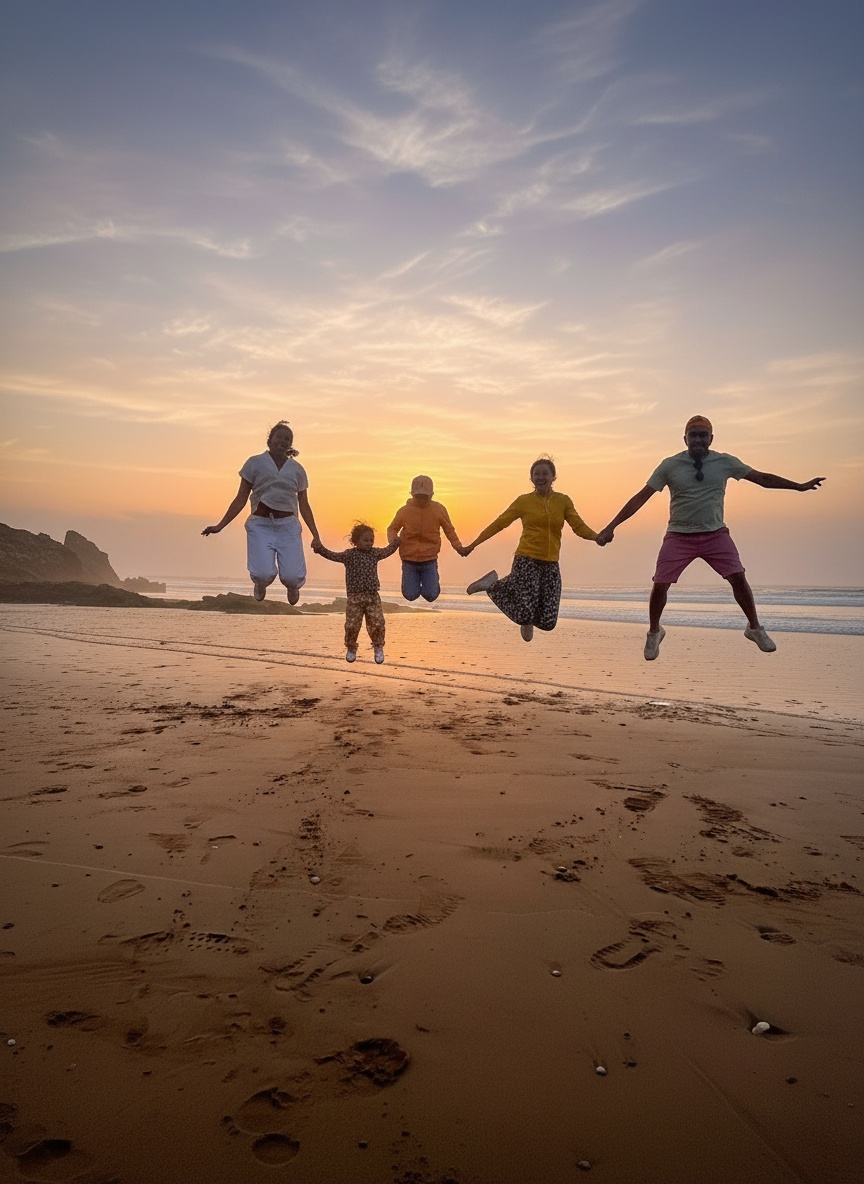
Some places you meet through a photograph, and Sidi M'Barek is one of them: a green valley dropping towards the Atlantic, an empty beach, a thread of fresh water falling into the sea. The picture travels, the place intrigues, and the practical information never turns up.
Here is the practical information, including the parts that do not photograph well. Sidi M'Barek is one of the finest stretches of coast south of Essaouira. It is also the one people most often reach with the wrong expectations: the waterfall in the name is not a permanent one, the beach has no lifeguard and no café, and the final stretch of road puts off most rental cars.
None of that is a problem, as long as you know it before you set off.
Where Sidi M'Barek actually is
The landmark is easy: head south down the coast, and keep going past Sidi Kaouki.
- The site sits roughly 35 kilometres south of Essaouira, on the Atlantic coast.
- You pass Sidi Kaouki first, then carry on for another dozen kilometres.
- Allow about an hour from Essaouira, more if you stop on the way, which everybody does.
- There are no road signs at all. This is what sends independent visitors round in circles: the track down to the sea does not announce itself.
- On site: a hamlet, the white marabout of Sidi M'Barek, a valley terraced with small fields, cliffs, dunes, sea caves and a long sand beach.
All of it sits within a few hundred metres, which is why half a day is plenty.
The waterfall: what to know before making the drive
Let us get this out of the way, because nobody else says it: the Sidi M'Barek waterfall is not a permanent one. It is the outlet of a seasonal stream fed by rain. When it has rained, it runs. When it has not, it thins to a seep across the rock and the pools on the slope sit dry.
That is seasonality, not a let-down. Morocco is coming out of seven consecutive years of rainfall deficit, and visitor reports from those seasons all describe the same thing, a cascade that is "almost dry" in a setting that remains beautiful anyway. Then the winter of 2025-2026 changed the picture: according to Morocco's national meteorological office, it delivered 136 millimetres of rain nationally across December, January and February, against 71 millimetres in a normal year, spread over 36 rainy days instead of 17. It was the country's third wettest winter since 1981.
What that means for a visitor: the waterfall follows the rain, not the tourist calendar. The question to ask is not "which season" but "has it rained lately".
| Period | Rainy days per month in Essaouira | The waterfall | The walk |
|---|---|---|---|
| November to January | 4.0 to 4.7 | the best window, especially in the days after rain | ground greasy in places, low and beautiful light |
| February to April | 2.3 to 3.9 | still running in good years, worth checking before you drive | the greenest time of year, mild temperatures |
| May to September | 0.1 to 0.9 | dry, or down to a trickle | fully exposed with no shade, go early |
| October | 2.6 | can restart after the first rains | ideal temperatures and almost nobody there |
If you are still picking dates, our guide to the best time to visit Essaouira goes through each season, and our piece on Essaouira out of season explains why November and December are often the coast's best months.
The beach: wild in the literal sense
Sidi M'Barek is not a developed beach that has been allowed to run down. It never had anything, and that is exactly what people come for.
- No lifeguard station, no lifeguard, no café, no shop, no parasols.
- No drinking water. Whatever you drink, you carry in.
- No reliable phone signal, and no card payment anywhere.
- Open ocean, with currents. Whether to swim is judged on the day, in front of the water, by asking someone local. It is not a decision to make from an article.
- Plenty of wind in the afternoon, as everywhere on this coast. That mechanism is set out in our guide to the wind in Essaouira, and it applies here like anywhere else: calm mornings, brisk afternoons.
In exchange, it is not unusual to have several hundred metres of sand to yourself, even in August. That has become rare along this coast, and our round-up of the finest beaches around Essaouira puts Sidi M'Barek among the last of them.
What the walk is actually like
It is a walk, not a technical hike. There is some climbing, but the difficulty lies elsewhere.
You leave the vehicle at the top and drop towards the sea on old muleteer paths. Allow around forty minutes to reach the waterfall and half an hour to climb back, with a few short ascents. The ground alternates between sand, rock and streambed, which makes closed shoes a much better idea than flip-flops.
What stays with you is what the route contains rather than how long it is. In an hour of walking you pass argan and almond trees, terraced fields, beehives, herds of goats, sometimes laundry drying beside the fresh water. Local life has not arranged itself for your benefit; it is simply there.
The real difficulty is the absence of shade. The route is exposed from end to end. In summer that alone turns a pleasant stroll into an ordeal if you set off at two in the afternoon.
Our Sidi M'Barek coastal walk covers exactly this route in two to three hours, with a local guide, a tea stop at a family home and transport from Essaouira for groups of five or more. It solves both of the site's problems at once: finding the track, and knowing where to put your feet.
For tired legs in the evening, see our hammam guide.
Three ways to get there
| Option | What it takes | Time on site | Who it suits |
|---|---|---|---|
| Own car and walk | a vehicle that can handle a dirt track, and knowing exactly where to stop | 2 hrs to half a day | people who already know this coast |
| Guided walk from Essaouira | nothing, transport and guide are arranged | 2 to 3 hrs | a first visit, a family, or no car |
| Riding | getting into the saddle, and nothing else | depends on the option | anyone who would rather not walk back up |
The third option deserves a word: the descent, and above all the climb back up, can be done on a donkey or a camel. It is the historic local solution, the one that lets you bring children or grandparents on a route they would not walk. It is not a tourist gimmick, it is how people here move.
What to bring
Short list, and it heads off nearly every unpleasant surprise.
- Closed shoes. The streambed and wet rock are unforgiving in flip-flops.
- More water than you think. There is nothing on site.
- A light windbreaker, in every season, August included.
- A hat with a chin strap, sunscreen, and sunglasses that stay on. There is no shade at any point.
- Cash. The tea, the ride, the helping hand: all of it settles in cash.
- Something to protect a camera. Between the sand and the spray, that is the real equipment risk of the day.
To fit the walk into a full day's budget, read how much a day in Essaouira really costs.
What time to go
The morning, without hesitation, for three reasons: the light is better, the wind has not filled in yet, and the heat is still manageable on a route with no shade.
Sunset is magnificent, the coast faces west and the cliffs catch fire. But you then climb back by head torch on a path you do not know, and nothing lights the track home. If you want the dusk, do it with someone who knows the way. It is also what makes a Berber dinner on a wild beach far easier to pull off than an improvised picnic in the same spot.
What to combine it with
Sidi M'Barek slots in well, because you are heading down the coast anyway.
- Sidi Kaouki is on the way, and one of the busiest surf spots in the area. A session in the morning, the walk in the afternoon, and the day is full.
- The argan forest lines the whole road south. That is where the cooperatives are, and incidentally the goats in the trees.
- The river mouth and the wetlands nearby make birdwatching a serious activity here rather than a pretext.
- A traditional fishing trip at first light gives you the same coastline seen from the water.
- To cover more ground without losing the day to it, a buggy ride follows the shore and the dunes.
- Inland, the Ain Lahjer oasis offers the exact opposite: water, shade, and not a breath of wind.
And if the day ends with heavy legs, a hammam and a traditional treatment back in town is the logical conclusion. Our guide to Essaouira's beaches and our three day itinerary cover the rest, from the medina's traditional markets to a guided tour for the days you stay inside the ramparts.
Do you need a guide?
Honestly, it comes down to one thing: how much you mind driving in circles.
With a suitable vehicle, an offline map and some experience of rural Morocco, the place can be found. Without that, the track does not announce itself, the descent is unmarked, and people regularly drive home without having seen the waterfall at all. A local guide brings three things no app replaces: they know where to turn off, they know whether the water is running right now, and they know the house where you drink the tea.
This is the kind of place where the difference between a good day and a wasted one is not the location. It is the information.