Pottery workshops in Essaouira: what you actually learn
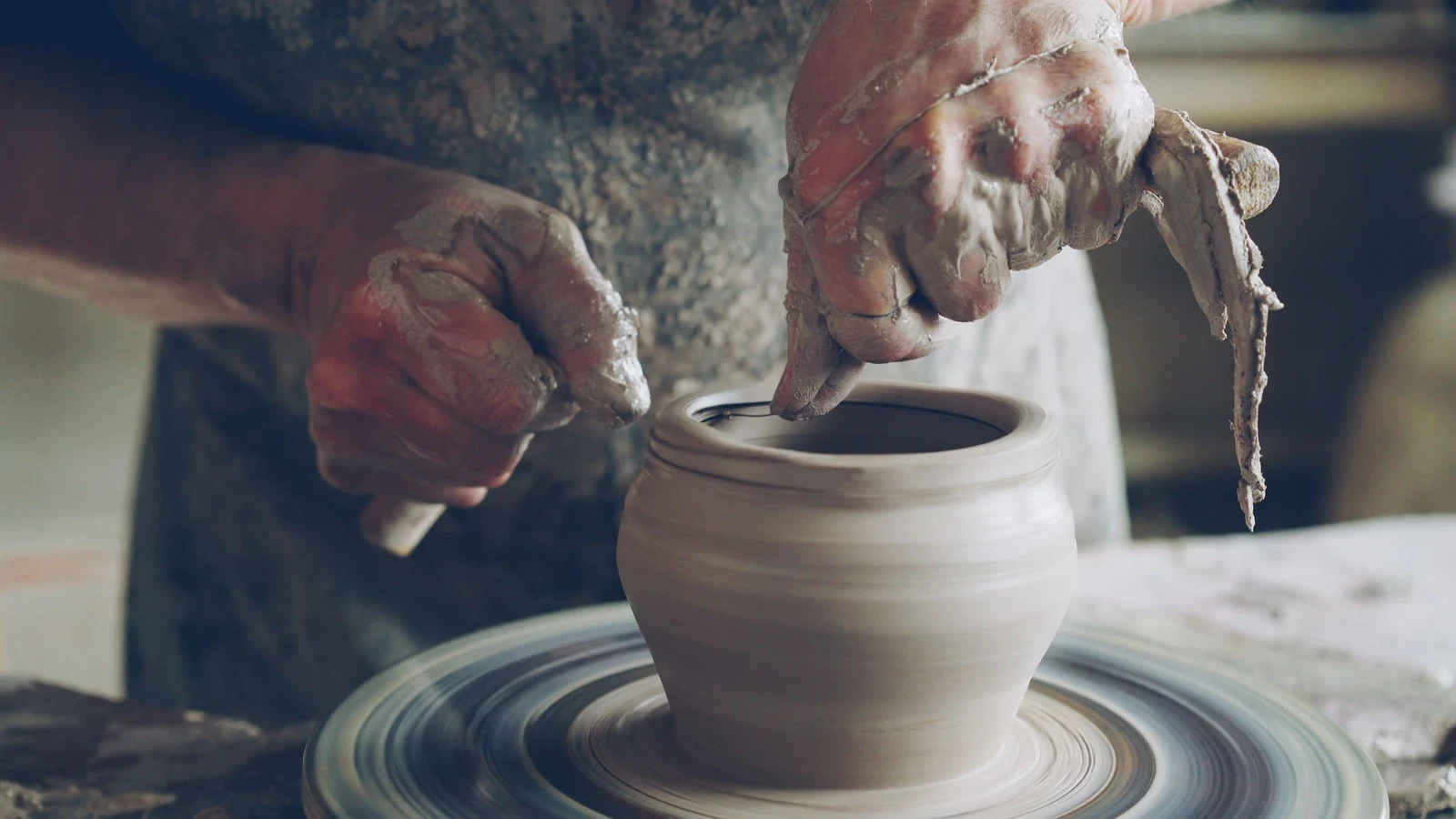
Most listings for a pottery class tell you the price and the duration. Almost none tell you what happens to your hands in those two hours, which is the only part you will remember a year later.
Clay is an unusually honest teacher. It punishes a rushed movement immediately, it collapses when the wall gets too thin, and it gives you the feedback within seconds rather than at the end of a term. That is why a single short session in Essaouira teaches more than you would expect, and why the question worth asking before you book is not how much, but which format.
The pottery and crafts workshop page already lists the five formats with current prices and opening hours. This guide covers the part that page cannot: what each one actually teaches, what the session feels like from the inside, and how to pick.
Why learn pottery in Morocco rather than at home
You could take a ceramics class in your own city. What you would not get there is the living supply chain sitting a short drive away.
Pottery in Morocco is not a tourist decoration, it is an old and uninterrupted industry. In Safi, 123 km north of Essaouira (roughly two hours by road according to route calculators), ceramics are documented as far back as the 12th century. The city now counts more than 700 craftspeople across 42 workshops, equipped with 72 traditional kilns and 27 gas kilns, and formal apprentice training was started there in 1920 by the master ceramicist Boujemaa Lamali (Le Matin).
Those numbers describe Safi, not Essaouira. They matter because they describe the tradition your session belongs to. Three practical consequences:
- the clays, the shapes and the glazes come from a documented regional practice rather than an interchangeable syllabus;
- one of the five formats, zouak, barely exists anywhere outside Morocco;
- the medina, where the same skills are traded every single day, is minutes away. A guided medina tour or an hour in the traditional markets after your session changes how you read everything you just made.
The five formats, side by side
| Format | Length | What it actually teaches | Adult | Child |
|---|---|---|---|---|
| Creative pottery | 2 h | Pinching, hollowing, smoothing. The exact relationship between finger pressure and wall thickness. | 350 Dhs | 290 Dhs, from age 3 |
| Wheel throwing | 2 h | Holding still while the clay moves. Centring, which is everything. | 360 Dhs | not listed |
| Ceramic painting | 2 h | A loaded brush, and pigments that only reveal their real colour after firing. | 360 Dhs | 300 Dhs, from age 6 |
| Zouak on wood | 2 h 30 | Repeating a freehand motif with no way to correct a stroke. | 380 Dhs | 320 Dhs |
| Raku course, 2 sessions | 2 h + 1 h 30 | The whole chain: shaping, glazing, firing, thermal shock. | 750 Dhs | not listed |
Lengths and prices from the Enjoy Essaouira workshop page, checked in October 2026. Workshops run Monday to Saturday between 10 am and 5 pm. Materials and the finished piece are included in every format.
What the two hours are really like
People expect a class. It is closer to three distinct phases, and nobody warns you about the second one.
- The first ten minutes are physical. Before you shape anything, you work the lump: knocking out air bubbles, getting it even. It tires your wrists, and no listing mentions it.
- Then something fails. A wall sags, a rim splits, the wheel throws your piece off centre. This is the useful part of the session. Your fingers learn a rule that nobody can explain to you in words.
- The last half hour is quiet. You smooth, you adjust, you sign the base. Most people stop talking around here.
If you bring children, watch the difference: they move through that sequence far faster than adults, because they are not trying to succeed. Our Essaouira with family guide covers how to fit a workshop into a day with them.
Raku in Essaouira: why it needs two sessions
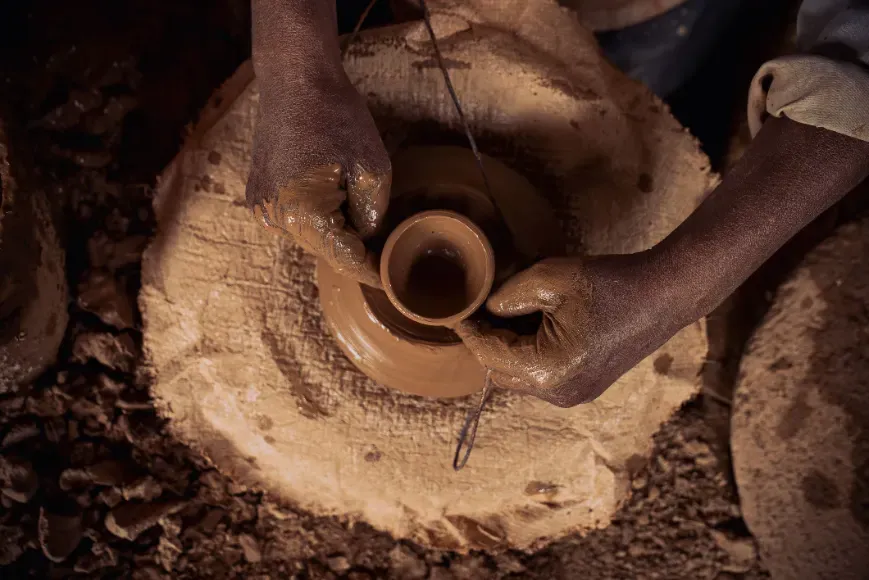
Raku is the only format in the catalogue split across two appointments, and that is not a scheduling preference. The technique demands it.
Raku began in 16th century Kyoto. The potter Chôjirô hand-shaped tea bowls for the tea master Sen no Rikyû, and it was his son Jokei who received from Toyotomi Hideyoshi the seal bearing the character raku, usually translated as enjoyment (Wikipedia). The firing has nothing in common with a normal kiln cycle. The piece is pulled out at full heat, around 980 °C, buried in wood shavings or vegetation until it drops to roughly 500 °C, then plunged into cold water to lock the colours in (Japan Experience). Those successive thermal shocks produce the crackle and the metallic sheen, and there is no shortcut to them.
| Session | Length | What you do |
|---|---|---|
| First | 2 h | Shaping, choosing the form, setting the piece to dry |
| Second | 1 h 30 | Glazing, raku firing, opening the kiln, cooling |
Two sessions, then, because a damp piece can be neither glazed nor fired. In between there is drying and a temperature climb. It is also the only format where you witness the part workshops usually keep backstage: the kiln opening. At 750 Dhs it is the closest thing here to real tuition, and the only one that deserves the word course.
Zouak: the workshop you will not find at home
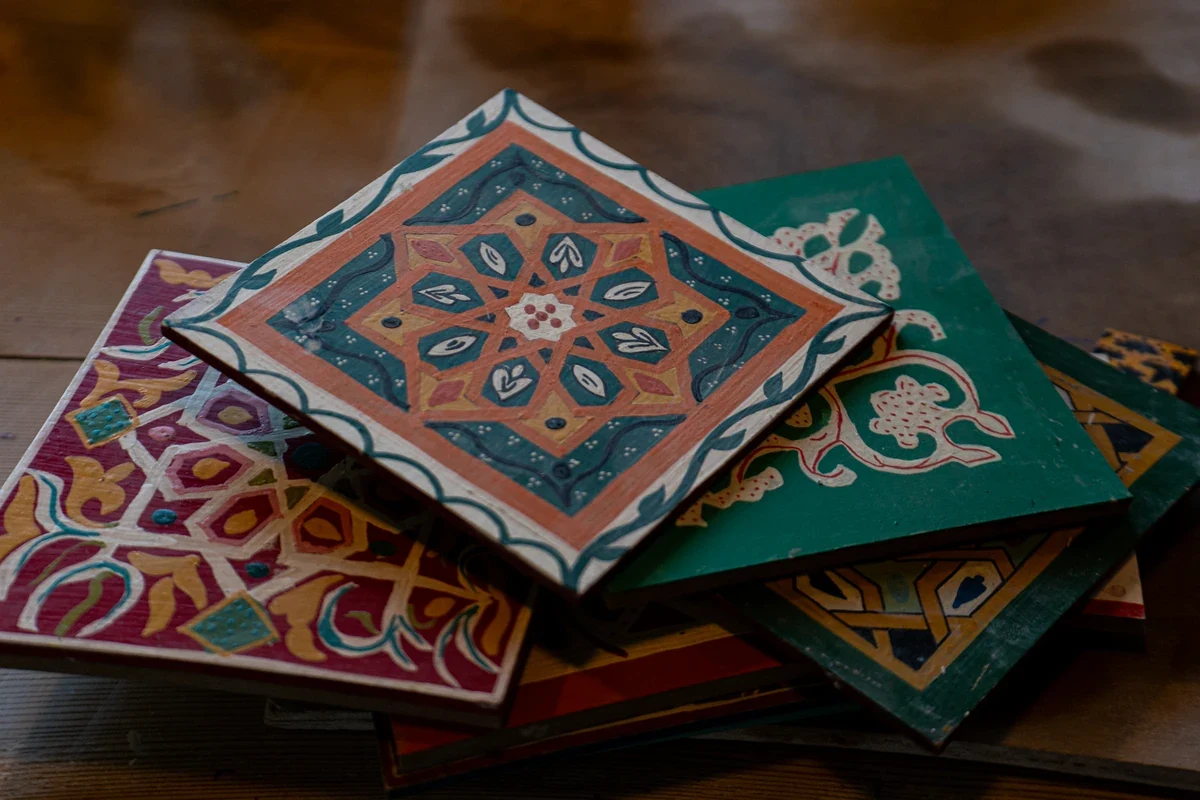
Zouak is traditional Moroccan painting on wood: fine interlacing patterns, repeated freehand across ceilings, doors and chests. The session runs 2 h 30, the longest of the five apart from raku, and costs 380 Dhs for two pieces.
What it teaches has almost nothing to do with clay:
- holding a very fine brush unsupported, letting the wrist follow the curve instead of fighting it;
- accepting that a stroke cannot be undone, which rewires your whole relationship with mistakes;
- reading a geometric pattern as a grammar, with its repetitions, its axes and its pauses.
Pick it if you came for your eye rather than your hands. It pairs well with the city's other crafts: a solidarity embroidery workshop in the morning, zouak in the afternoon, and you have spent a full day inside Essaouira's trades. If you would rather draw or personalise an object, the artistic expression workshop and the basket embroidery workshop extend the same idea, and a hike through the thuya forest shows you the tree the medina's woodworkers take their wood from. Our article on Essaouira, city of artists explains why these crafts have gathered here for decades.
Can you take your piece home? The honest answer
This is the most common question and the one most sites dodge. Here is what can actually be said.
Your piece is included in the workshop price, materials too. But raw clay has to dry before it can be fired, and firing happens in a kiln at high temperature: for earthenware, the first firing sits around 1 100 °C and the glaze firing around 1 050 °C (Youschool). Nothing shaped in the morning comes out finished that afternoon, anywhere in the world.
What that means in practice:
- staying several days in Essaouira: ask for the turnaround when you book, and plan to come back for it;
- leaving tomorrow: choose ceramic painting, where you decorate pieces that are already formed and the timeline is far simpler;
- either way, ask before the session rather than after, on WhatsApp.
Which format fits you
- Travelling with small children: creative pottery, from age 3, two hours, 290 Dhs per child.
- After the most satisfying single skill: wheel throwing. Two hours is enough to centre a piece, and failure is so visible that success feels genuinely earned.
- You draw, paint or photograph: zouak or ceramic painting, depending on whether you prefer wood or clay.
- You have two slots and want to actually learn something: the raku course, without hesitation.
- The wind has wrecked your beach plan: any of the five. A workshop is one of the best answers to an Essaouira windy afternoon, and our guide to the wind explains when it blows and what to do with those days.
Practical notes before you book
- Hours: Monday to Saturday, 10 am to 5 pm. No workshops on Sunday.
- Level: no prerequisite for any of the five, complete beginners included.
- Clothes: clay washes out, but wear something you do not love, and keep your nails short if you are throwing.
- Budget: 350 to 750 Dhs depending on the format. To place that inside a full day, our cost of a day in Essaouira article prices every line.
- Pairing: a cooking workshop in the morning and pottery after lunch works well. If you want to finish with a hammam and the wellness traditions, save it for the end of the day.
- Getting there: the workshops are walkable from the medina. If you are staying outside town, a private transfer settles it.
Book your workshop
Tell us how many of you there are, which day, and whether you want a short format or the full course: we will point you to the one that fits, not the most expensive one.